How to Build an AI Agent: A Guide for Beginners

V Chaitanya Chowdari
May 24, 2025

AI Agents: The Next Frontier Beyond Chatbots
We’re past the novelty phase of ChatGPT and Claude. They’ve done a good job democratizing AI access, but they aren’t the real game-changer. That title goes to autonomous AI agents — entities capable of perceiving, reasoning, and acting independently with minimal human input. It’s no surprise that over half of today’s users are already working with some form of agent.
These agents aren’t bound by rigid instructions like traditional automation. They adapt, evolve, and make contextual decisions based on real-world data.
Whether you’re a developer pushing boundaries or an enterprise leader aiming to cut inefficiencies, this breakdown clarifies what AI agents are, what makes them work, and how you can start building or deploying them effectively.
What Exactly Is an AI Agent?
At its core, an AI agent is autonomous software with the ability to observe its environment, make decisions, and execute actions in pursuit of defined objectives.
This isn’t your average chatbot. Agentic systems don’t just follow a script — they understand the situation, make decisions, and learn continuously.
Key Traits:
Example? One agent can onboard a new hire by provisioning access and delivering resources. Multiple agents working together? You’re looking at an intelligent, fully automated onboarding flow from end-to-end — including IT provisioning, compliance briefings, and customized training.
Why This Matters Now
As enterprises seek scalable automation, agentic systems enable end-to-end workflows that go far beyond answering questions. They actively perform tasks.
To explore this shift, see our webinar: The Age of AI Agents: How LLMs Will Ultimately Transform Your Business — a deep dive into what’s coming next.
Types of AI Agents in the Wild
There’s no one-size-fits-all here. Different agents are built for different tasks. Effective automation usually means orchestrating several types together.
Anatomy of an AI Agent
To function autonomously, every agent needs a tight loop of sensing, reasoning, and acting. Here’s how it breaks down:
1. Sensors
These are the inputs — data streams, APIs, user interactions, physical sensors. For enterprise agents, this might include HRIS updates, support ticket metadata, or policy changes.
2. Intelligence (Reasoning Engine)
This is where LLMs and other models come in. Agents analyze inputs, detect intent, map context, manage memory, and strategize actions.
NLP powers dynamic interaction. But the real edge lies in reasoning — agents know how to interpret, adapt, and resolve — not just respond.
3. Actuators
In software terms, these are the outputs. Actuators send emails, make API calls, push updates, and take real action. This is execution at scale.
4. Plugins
Plugins extend capability — connecting agents with enterprise platforms, third-party services, or external knowledge bases.
Building AI Agents: Your Three Paths
1. Build from Scratch
Total control — but high cost. You’ll need machine learning engineers, data pipelines, custom integrations, and non-stop maintenance. This isn’t feasible unless you’ve got deep internal capabilities and time to burn.
2. Use an Agentic Framework
These are modular toolkits designed for rapid agent development — offering a balance between control and efficiency.
Top Frameworks:
Build Process:
Ideal if you need flexibility but don’t want to build every component from the ground up.
3. Use an AI Agent Builder Platform
Platforms like Moveworks Creator Studio, Dialogflow, and Microsoft Bot Framework offer low-code/no-code interfaces with enterprise-ready integration, security, and scaling tools built-in.
You get plug-and-play functionality with rapid deployment — perfect for teams that need real-world results without managing complex infrastructure.
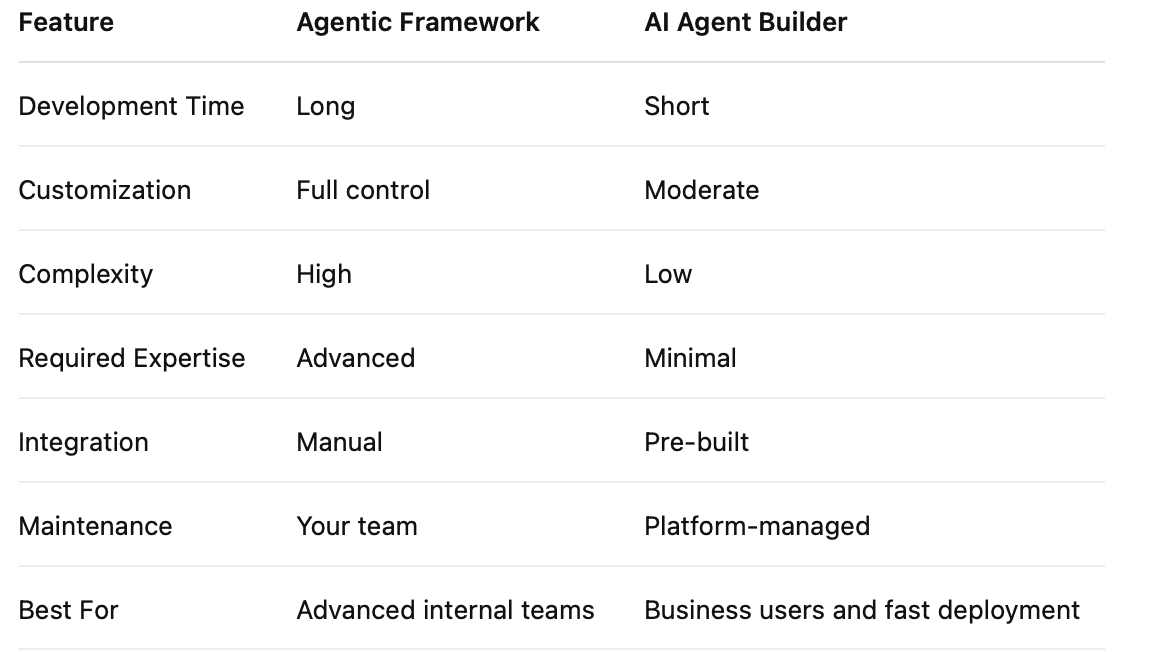
Agentic Framework vs. AI Agent Builder: A Strategic Comparison
Final Word: Start Where It Makes Sense
Building custom agents gives you freedom — but comes with resource commitments. Frameworks provide flexibility; platforms provide speed.
If you’re ready to unlock scalable automation and free up teams from repetitive tasks, solutions like Moveworks Creator Studio offer a practical on-ramp:
You don’t need another chatbot. You need an intelligent system that gets real work done.